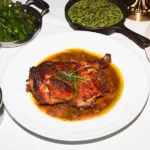
The long exposed bone catches your attention first, but a great Tomahawk should offer much more than dramatic presentation. The quality of the beef, marbling, thickness, aging process, cooking method, doneness, resting time, and service all influence what eventually reaches your plate.
If you’re searching for Tomahawk steak NYC options, understanding those details makes it easier to distinguish a genuinely memorable steak from one that simply looks impressive in a photograph.
At Andrew Steak Society in Manhattan’s East Village, the signature Tomahawk is dry-aged for 45 days and finished over a live wood-fired grill. That approach puts aging and fire—not simply size—at the center of the experience.
This guide explains what you’re actually ordering, what to look for, how to enjoy it, and why the preparation matters.

What Exactly Is a Tomahawk Steak?
A Tomahawk steak is essentially a bone-in ribeye cut with a long section of rib bone intentionally left attached.
The shape resembles a tomahawk axe, which explains the name.
But the bone is only part of its appeal.
The steak comes from the rib section, meaning it shares the rich marbling that makes ribeye one of the most popular steakhouse cuts.
A Tomahawk is also generally cut thick.
That thickness creates an interesting challenge for the kitchen: develop a deeply browned exterior while bringing the center to the requested temperature without overcooking the outer layers.
When done correctly, that contrast is a major part of the appeal.
Tomahawk vs Ribeye: what’s the difference?
They come from the same general rib section, but their presentation differs.
| Feature | Tomahawk | Ribeye |
| Cut | Rib section | Rib section |
| Bone | Long rib bone attached | Boneless or shorter bone |
| Thickness | Usually very thick | Varies |
| Marbling | Typically high | Typically high |
| Presentation | Dramatic centerpiece | Traditional steak |
| Sharing | Often suitable | Usually individual |
| Best occasion | Sharing, celebrations, steak experiences | Individual steak dinner |
A Tomahawk isn’t automatically better than a ribeye.
It simply creates a different dining experience.
If you want an individual steak with minimal ceremony, a ribeye may make more sense. If you want the steak to become the centerpiece of dinner, the Tomahawk has a clear advantage.
Why Is Tomahawk Steak So Popular in NYC?
New York already has one of America’s most established steakhouse cultures.
In a city where diners can choose among Porterhouse, New York Strip, Filet Mignon, Ribeye, Wagyu and countless other preparations, a Tomahawk has to do something distinctive.
Part of its popularity is visual.
A large steak with a long bone arriving at the table naturally gets attention.
But presentation alone doesn’t explain why serious steak diners order it.
It turns dinner into a shared experience
A Tomahawk is often large enough to share.
Instead of two people concentrating on separate entrées, the table can build the meal around one central steak with several sides and sauces.
That makes it especially suitable for:
- Date nights
- Birthdays
- Anniversaries
- Business dinners
- Celebrations
- Steak-focused dinners with friends
The experience becomes more social because choosing, slicing, sharing and pairing the steak are all part of the meal.
What Should You Look for When Ordering Tomahawk Steak in NYC?
Not all Tomahawks are prepared the same way.
Before choosing a restaurant solely because a large steak appears on its Instagram feed, consider these factors.
1. Ask about the beef
A great steak starts before it reaches the grill.
The restaurant should be able to explain what it serves rather than relying entirely on words such as “premium” or “signature.”
2. Look at the aging process
Aging can have a significant effect on both flavor and texture.
If a menu says “dry-aged,” look for information about the aging period.
Specificity gives diners more useful information than marketing language alone.
3. Consider the cooking method
Steakhouses use different methods to develop the exterior crust and control the internal temperature.
Some rely on high-temperature broilers. Others use gas grills, charcoal or live fire.
None should be judged by terminology alone; execution matters.
But the cooking method can noticeably influence the final character of the steak.
4. Think about thickness, not only weight
A large number on a menu does not automatically guarantee a better experience.
Thickness influences how the kitchen can balance exterior browning with internal doneness.
5. Ask how many people it serves
Do not assume.
Appetite, steak size, starters and sides all affect how many people a Tomahawk can reasonably feed.
Ask your server for guidance based on the meal you’re planning.
Why Dry Aging Matters for a Tomahawk
Dry aging is one of the most interesting variables when comparing premium steaks.
During the process, beef is stored in a carefully controlled environment where temperature, airflow and humidity are managed.
Two important changes occur over time.
Moisture is gradually lost
As moisture leaves the beef, its flavor becomes more concentrated.
Natural enzymes affect texture
Enzymatic activity gradually changes muscle structure, influencing tenderness.
As aging continues, the flavor can become more pronounced and distinctive.
That doesn’t mean the longest-aged steak is automatically the best.
Aging is partly about preference.
Some diners enjoy a relatively straightforward beef flavor. Others specifically seek the deeper, nuttier and more developed characteristics associated with extended dry aging.
The 45-Day Tomahawk at Andrew Steak Society
Andrew Steak Society dry-ages its signature Tomahawk for 45 days.
That detail is important because it gives diners a clear understanding of how the restaurant approaches its signature cut.
The restaurant’s other steaks are aged for a minimum of 28 days, while the Tomahawk receives additional aging.
After that process, the steak is finished over a live wood-fired grill.
These two techniques work together in different ways.
Dry aging develops the beef before cooking.
Live fire shapes the exterior during cooking.
The result is designed around concentrated beef flavor, exterior caramelization and subtle smoky characteristics from the fire.
Why Cook a Tomahawk Over Wood Fire?
A thick steak needs serious heat.
High heat helps create the browned exterior that contrasts with the interior of the steak.
Wood fire adds another variable: aroma.
When properly managed, it can introduce a subtle smoky character without overwhelming the flavor developed during aging.
The crust matters
The browned surface of a properly cooked steak is more than visual.
High heat encourages the Maillard reaction—a series of chemical reactions involving amino acids and reducing sugars that creates the browned flavors and aromas associated with seared meat.
For a thick Tomahawk, that exterior-to-interior contrast is particularly important.
The goal isn’t simply to burn the outside.
It is to develop a flavorful crust while maintaining control over the center.
What Doneness Should You Choose?
There is no universal “correct” steak temperature because personal preference matters.
However, highly marbled cuts benefit from enough heat for their fat to render.
Here’s a practical guide:
| Doneness | General Character |
| Rare | Cool-to-warm red center |
| Medium-rare | Warm red center with good moisture |
| Medium | Warm pink center |
| Medium-well | Slight pink remaining |
| Well-done | Fully cooked through |
For a richly marbled Tomahawk, medium-rare is a popular starting point because it balances tenderness, moisture and fat rendering.
But order the steak the way you genuinely enjoy it.
A technically fashionable temperature isn’t useful if you don’t like eating steak that way.
Why Resting the Steak Matters
Cooking doesn’t end the second a steak leaves the fire.
A thick Tomahawk retains significant heat.
Resting allows the temperature to stabilize before slicing and helps the steak transition from grill to table.
This is especially relevant for a thick cut because the difference between the surface and center can be substantial immediately after cooking.
Good steak preparation therefore requires patience at both ends:
time during aging and time after cooking.
How Should You Order a Tomahawk for Two?
If you’re sharing, think about the entire table rather than ordering every dish independently.
A simple progression works well.
Step 1: Start lighter
Choose an appetizer or salad that won’t overwhelm your appetite before the steak arrives.
Step 2: Make the Tomahawk the centerpiece
If you’ve specifically come for the steak, let it remain the focus.
Ask your server whether the available portion is appropriate for your table.
Step 3: Add contrasting sides
A rich steak benefits from sides with different textures and flavors.
Instead of ordering only rich accompaniments, consider balancing indulgent choices with something fresher or lighter.
Step 4: Choose sauces selectively
Taste the steak first.
A well-aged, properly cooked steak should have enough character to stand on its own.
Then experiment with sauces or flavored butters according to preference.
Step 5: Don’t rush dessert
A Tomahawk dinner is naturally substantial.
Give yourself time before deciding whether the table wants dessert or another drink.
Ordering Tip: Tell your server how many people are sharing and what else you plan to order. Portion guidance is more useful than choosing solely according to the steak’s weight.
Tomahawk vs Other Steakhouse Cuts
The Tomahawk isn’t right for every diner.
Choosing based on preference is better than ordering based on spectacle.
| Cut | Choose It If You Want |
| Tomahawk | Marbling, presentation and sharing |
| Ribeye | Rich flavor without the long-bone presentation |
| Porterhouse | Two steak textures in one cut |
| New York Strip | Firmer texture and strong beef character |
| Filet Mignon | Maximum tenderness and a leaner experience |
For two people looking to share a centerpiece, the Tomahawk makes sense.
For someone dining alone, another cut may provide a more practical portion while delivering an equally serious steak experience.
What Makes a Tomahawk Worth Ordering?
The long bone alone doesn’t justify the experience.
A Tomahawk becomes worthwhile when the restaurant handles the entire process well.
Look for:
- Quality beef
- Strong marbling
- Meaningful aging
- Proper temperature control
- A well-developed crust
- Adequate resting
- Knowledgeable service
- Thoughtful slicing and presentation
- Sides that complement rather than overwhelm the steak
Most importantly, there should be a reason the restaurant serves the cut beyond its ability to attract attention on social media.
At Andrew Steak Society, that reason is built around the 45-day dry-aging period and live wood-fire preparation.
Why the East Village Setting Changes the Experience
The traditional image of a New York steakhouse often involves Midtown, dark wood, formal service and a business-dinner atmosphere.
The East Village offers another context.
Dinner can be part of a larger downtown evening rather than a standalone formal event.
You can meet for drinks, share a steak, walk through the neighborhood afterward, or continue the evening nearby.
Andrew Steak Society is located at 51 Avenue B in Manhattan’s East Village, placing the Tomahawk experience inside one of the city’s most recognizable dining and nightlife neighborhoods.
That makes the restaurant particularly practical for date nights, celebrations and dinners where guests want something to do before or after the meal.
Benefits of Choosing a Tomahawk for Your Next Steak Dinner
A well-prepared Tomahawk offers several advantages:
- It encourages sharing. The steak can become a centerpiece for the table.
- It offers ribeye-style richness. Marbling gives the cut its characteristic richness.
- Its thickness supports contrast. A skilled kitchen can build a strong exterior while controlling the center.
- It suits special occasions. The presentation naturally creates a sense of occasion.
- It pairs easily with steakhouse sides. Diners can customize the overall meal around the central cut.
- It creates a memorable experience. Aging, fire, slicing and presentation can make the steak part of the evening rather than simply another entrée.
Frequently Asked Questions About Tomahawk Steak NYC
1. What is a Tomahawk steak?
A Tomahawk is a thick bone-in ribeye with an extended section of rib bone attached. It combines the marbling associated with ribeye with a distinctive long-bone presentation.
2. Where can I get Tomahawk steak in NYC?
Several New York steakhouses offer Tomahawk cuts. Andrew Steak Society serves a 45-day dry-aged Tomahawk at 51 Avenue B in Manhattan’s East Village.
3. How long is Andrew Steak Society’s Tomahawk dry-aged?
The restaurant’s signature Tomahawk is dry-aged for 45 days before being finished over a live wood-fired grill.
4. Is Tomahawk steak the same as ribeye?
They are closely related. A Tomahawk is essentially a bone-in ribeye distinguished by the long rib bone left attached and its typically thick, large-format presentation.
5. Is a Tomahawk good for two people?
It often can be, depending on its size, appetite and how many starters and sides you order. Ask the restaurant for portion guidance rather than assuming based on appearance.
6. What doneness is good for Tomahawk steak?
Medium-rare is popular for highly marbled rib cuts because it provides enough heat to begin rendering the fat while maintaining a tender, juicy center. Personal preference should ultimately determine your order.
7. Why is Tomahawk steak more expensive?
Several factors can influence price, including beef quality, size, aging, preparation, trimming and restaurant operations. Dry aging can also increase costs because it requires controlled storage, time and product loss.
8. Is dry-aged Tomahawk different from regular Tomahawk?
Yes. Dry aging changes the steak before cooking through moisture loss and enzymatic activity, which can create a more concentrated and developed flavor profile.
9. What should I eat with a Tomahawk?
Choose sides that provide contrast. Potatoes and other classic steakhouse sides work well, but adding vegetables, salad or brighter accompaniments can balance the richness of the beef.
10. Is Tomahawk steak worth ordering for a special occasion?
It can be an excellent choice when you value sharing, presentation and a substantial steak experience. Look beyond size, however—the quality of the beef, aging and preparation determine whether the experience justifies the occasion.
The Tomahawk Experience Is About More Than the Bone
Searching for Tomahawk steak NYC options will give you plenty of dramatic photographs.
But the long bone should be the beginning of the conversation, not the reason you choose the steak.
Ask how the beef is aged. Understand how it’s cooked. Choose your preferred doneness. Build the rest of the table around the cut rather than overwhelming it with food. Most importantly, choose a steakhouse that can explain why its Tomahawk deserves to be a signature dish.
At Andrew Steak Society, the answer starts before the steak reaches the fire: a 45-day dry-aging period followed by a finish over a live wood-fired grill in the East Village.
For diners who want their next steak dinner to center on dry aging, live fire and a cut designed for sharing, make the reservation and experience the signature Tomahawk at Andrew Steak Society.
You might also like
-
Upscale Restaurants in the East Village NYC: A Guide to Dining Well Downtown

-
Dry-Aged Steak in Manhattan: What Makes a Steakhouse Worth It?

-
Best Tomahawk in NYC: A Guide to Upscale Steakhouse Dining

-
Steak East Village: A Guide to a Modern NYC Steakhouse Experience